RM06F9R10CT 交叉参考报告:最佳等效型号
Point: Recent shifts in distributor inventories and engineering search behavior make fast, reliable cross-references essential. Evidence: cross-reference query volumes and lead‑time volatility for power MOSFETs have risen, increasing replacement searches and procurement pressure. Explanation: engineers facing extended lead times need a reproducible workflow and vetted shortlist so that design and procurement decisions can be made without costly redesigns.
Point: This document’s purpose is pragmatic: deliver a reproducible param‑first cross‑reference workflow and a concise shortlist format to speed qualification. Evidence: the workflow emphasizes hard electrical/mechanical filters, supply scoring, and bench validation steps. Explanation: following the steps below helps engineering teams qualify replacements faster and reduce field risk while maintaining performance.
1 — RM06F9R10CT at a glance (Background introduction)
1.1 Key electrical, mechanical and thermal specs to capture
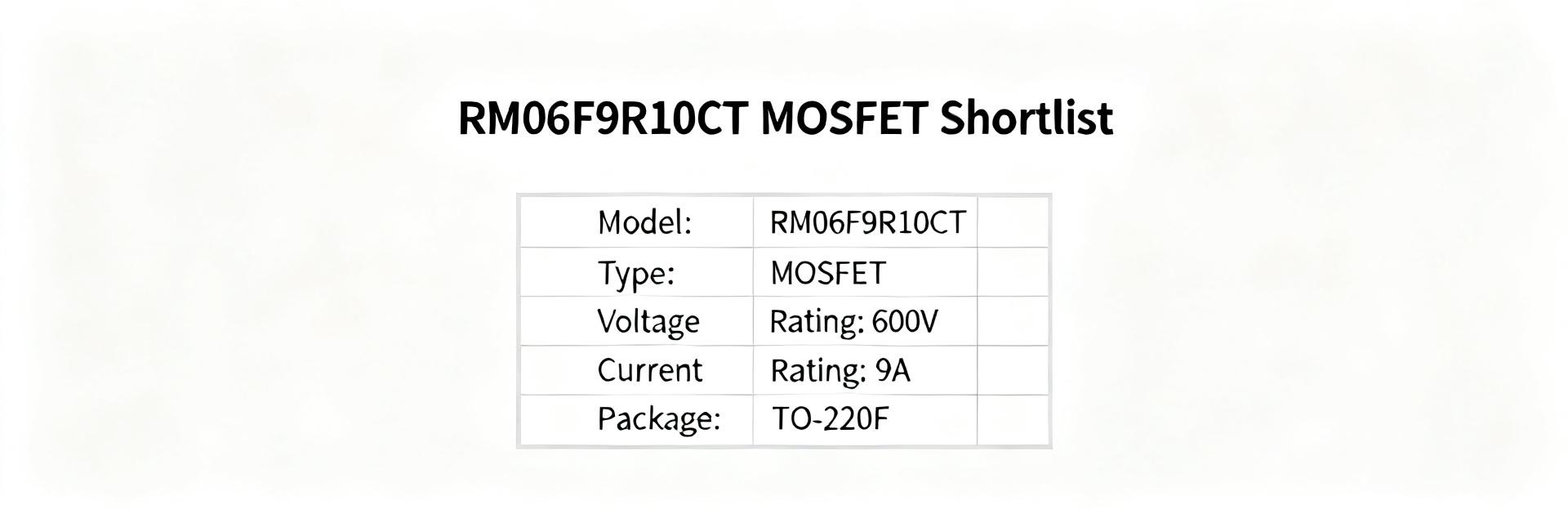
Point: Accurate cross‑reference begins with an exact datasheet capture. Evidence: comparing nominal values without full thermal and pulsed ratings leads to mismatches in real systems. Explanation: extract and record the precise fields below from the RM06F9R10CT datasheet before filtering candidates.
| Field | RM06F9R10CT (datasheet value — extract exact) |
|---|---|
| VDS (max) | — (extract exact V) |
| RDS(on) @ VGS & temperature | — (extract mΩ @ VGS, Tcase/Tj) |
| Continuous drain current (ID) | — (A) |
| Pulsed current (ID,pulse) | — (A) |
| Qg (total gate charge) | — (nC @ specified VGS) |
| VGS max | — (±V) |
| Avalanche / energy rating | — (J or specified test) |
| Package type & footprint | — (package name & land pattern) |
| Thermal resistance (θJA / θJC) | — (°C/W) |
| Max junction temperature | — (°C) |
| SOA notes | — (any derating or special SOA limits) |
1.2 Typical applications and why those specs matter for equivalents
Point: Application context defines which specs are non‑negotiable. Evidence: synchronous buck switches prioritize low RDS(on) and low Qg to minimize conduction and switching losses, while pre‑regulators may prioritize VDS margin and avalanche robustness. Explanation: map use cases (e.g., synchronous buck, DC‑DC pre‑regulator, load switch) to must‑have specs before accepting tradeoffs.
2 — Supply & performance data analysis for cross-referencing (Data analysis)
2.1 Availability and lead-time indicators to factor into selection
Point: Supply signals must be part of candidate scoring. Evidence: short‑term inventory snapshots, cumulative lead‑time feeds, and lifecycle flags indicate procurement risk. Explanation: score parts with an Availability × Performance × Lifecycle risk matrix to prioritize candidates for short, mid and long term sourcing.
Suggested scoring matrix (example): Availability score (0–5) × Performance match (0–5) × (1 − Lifecycle risk factor 0–0.5) = composite ranking. Use recent inventory snapshots (labeled “latest snapshot”) and update weekly for active BOMs.
2.2 Performance distribution and acceptable tolerance windows
Point: Define tolerances so filtering is repeatable. Evidence: practical thresholds—VDS ≥ original; RDS(on) within ±20% for conduction‑critical roles; Qg within ±30% for gate‑drive constraints; ID/pulse ≥ original—capture tradeoffs with distributions. Explanation: plot histograms of candidate RDS(on) and Qg when possible and flag parts with lower avalanche energy or narrower SOA as disqualifiers.
3 — Cross-reference methodology & selection criteria (Method guide)
3.1 Step-by-step param-first matching flow
Point: Apply a deterministic filtering flow to reduce bias. Evidence: follow hard filters first, then soften thresholds in controlled steps. Explanation: recommended flow — 1) Hard filters: VDS, footprint/pinout, VGS max, temp rating. 2) Soft filters: RDS(on), ID, Qg, θJA. 3) System checks: switching losses, SOA, avalanche. 4) BOM & lifecycle checks: part status, multiple sources, lead time.
Acceptance thresholds and fallback rules: accept RDS(on) up to +20% in non‑conduction‑critical paths; require parallel devices or keep margin if switching losses increase >10%; require ID/pulse ≥ original.
3.2 Validation, bench testing & qualification checklist
Point: Bench validation converts datasheet matches into system confidence. Evidence: reproducible tests include static parameter verification, switching loss bench tests, thermal imaging under steady load, avalanche/pulse tests and in‑system smoke tests. Explanation: define pass/fail criteria (e.g., measured RDS(on) within datasheet tolerance, temperature rise < defined limit at rated current) and sample sizes (recommended N=5 for initial qualification; expand to N=20 for production validation).
- Static check: confirm VDS, RDS(on) at VGS and temperature per datasheet.
- Switching test: measure turn‑on/off energy and extrapolate system switching losses.
- Thermal test: IR thermography at rated current and duty cycle; compare θJA expectations.
- Avalanche/pulse: execute controlled pulse per datasheet if the application expects inductive transients.
4 — Best equivalents shortlist & how to present them (Case display)
4.1 How to format each equivalent entry (required fields)
Point: Standardized entries speed review and procurement. Evidence: each candidate entry must include part ID, short rationale vs. RM06F9R10CT, key datasheet numbers, pin/footprint compatibility, availability snapshot, risk notes and validation priority. Explanation: this structure enables quick technical and procurement assessment and unambiguous inclusion into BOM alternates.
4.2 Template table and example interpretation
Point: A compact comparison table communicates tradeoffs. Evidence: use columns Candidate | VDS | RDS(on) @VGS | ID | Qg | Package | Footprint match | Availability | Why. Explanation: write one‑sentence rationales stating the primary tradeoff (e.g., slightly higher RDS(on) but better avalanche rating) and a recommendation (high/medium/low) for validation priority.
| Candidate | VDS | RDS(on) @VGS | ID | Qg | Package | Footprint match | Availability | Why |
|---|---|---|---|---|---|---|---|---|
| [Candidate A] | ≥ original | ±20% | ≥ original | ±30% | [pkg] | Exact/Adapter | Latest snapshot: qty / lead | Good electrical match; slightly higher Qg; medium validation priority. |
| [Candidate B] | ≥ original | Lower | ≥ original | Higher | [pkg] | Adapter needed | Latest snapshot: qty / lead | Better conduction, higher switching loss; recommend bench test. |
5 — Implementation & procurement playbook (Action suggestions)
5.1 BOM, procurement wording and lifecycle management
Point: Precise BOM language avoids ambiguity. Evidence: include the original part and approved alternatives, required datasheet clause and qualification status. Explanation: recommended BOM line: "RM06F9R10CT (primary) ; Approved alternates: [Candidate A], [Candidate B] — qualification status: [pass/under test]; vendor neutral footprint required; see qualification report ID."
5.2 Risk mitigation, multi-sourcing and last-time buy strategies
Point: Multi‑sourcing reduces supply risk. Evidence: qualify 2–3 equivalents, stagger purchases, hold safety stock and prepare footprint adapters. Explanation: set re‑qualification triggers (e.g., lead time >12 weeks or lifecycle status change) and plan last‑time buy quantities when lifecycle flags appear.
→ Summary
Point: A rigorous cross‑reference blends strict electrical/mechanical filters, supply‑aware scoring, and bench validation. Evidence: applying the param‑first flow, scoring availability, and executing the checklist reduces field and procurement risk. Explanation: immediate actions — build the parameter table, apply the matching flow, qualify top candidates, and add approved equivalents to the BOM with clear procurement phrasing.
Key Summary
- Capture the full RM06F9R10CT datasheet table before filtering so comparisons are exact and reproducible; this prevents hidden thermal or pulse mismatches in equivalents.
- Use a composite Availability × Performance × Lifecycle score to rank candidates for short, mid and long‑term sourcing decisions and update snapshots regularly.
- Apply deterministic hard filters first (VDS, footprint, VGS, temp) then soft filters (RDS(on), Qg); document fallback rules for acceptable tradeoffs and adapter needs.
- Validate top candidates with a bench checklist that includes static checks, switching loss measurement, thermal imaging and pulse/avalanche tests; set sampling and pass/fail criteria.
Frequently Asked Questions
How should I verify RM06F9R10CT electrical equivalence in the lab?
Point: Lab verification focuses on both static and dynamic behavior. Evidence: measure RDS(on) at the datasheet test conditions, perform switching loss bench tests at representative VDS and load, and run thermal imaging at rated current. Explanation: pass criteria include measured RDS(on) within datasheet tolerance, acceptable temperature rise under duty cycle, and switching loss impact within system budget.
What procurement wording should I use to add RM06F9R10CT equivalents to a BOM?
Point: Clear procurement language prevents substitute confusion. Evidence: include primary part, approved alternates, required datasheet clause and qualification status on the BOM line. Explanation: example phrasing — "RM06F9R10CT (primary); Approved alternates: [part IDs]; Qualification: lab report ID; Do not substitute without QC sign‑off."
Which RM06F9R10CT specs most often rule out a candidate despite similar RDS(on)?
Point: Thermal and transient specs commonly disqualify candidates. Evidence: parts with comparable RDS(on) can have lower avalanche energy, narrower SOA or higher θJA leading to system failures. Explanation: always compare avalanche/energy rating, SOA notes and thermal resistances, not just RDS(on) and Qg, before accepting an alternate.
What parameters and rules should guide footprint selection during RM06F9R10CT cross-referencing?
Point: Mechanical package and footprint matching must prioritize exact pin-to-pin alignment and package dimensions. Evidence: layout discrepancies can generate parasitic impedance or physical installation failures. Explanation: follow hard mechanical filters first, ensuring physical layout compatibility with the host PCB before softening performance requirements. When utilizing structural adapters, thermal path and parasitics must be validated.
SEO title: RM06F9R10CT Cross-Reference: Param-First Workflow & Equivalent Selection
Meta description: Reproducible cross-reference workflow and templates to qualify RM06F9R10CT equivalents fast — param filters, supply scoring, bench validation, and BOM phrasing.